Biserica Neagră (The Black Church)
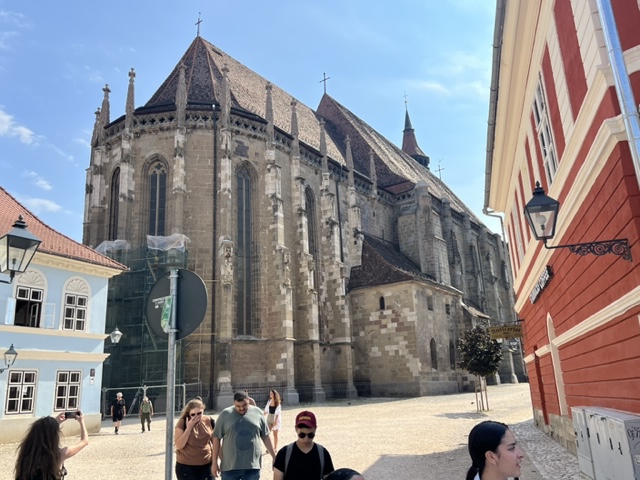
I had a very pleasant surprise during a recent trip to the Transylvanian region of Romania. While visiting the historic city of Braşov (pronounced Bra-Shav), my host took me to the beautiful Biserica Neagră or Black Church. Many believe that the unusual name is the result of a devastating fire in the late 17th century that left much of the building a smoke-blackened ruin. However, recent research on the fabric of the building has led others to believe that it is simply the result of environmental pollution that occurred during the 19th century as the city became a major industrial center. In any case, recent restoration efforts have left little trace of the previous discoloration that gave the church its’ name.
Settled by Teutonic Knights in the early 13th century, Braşov became an important German-speaking trading center as Saxon settlers were brought in under the protection of the well-known knightly order. Bringing with them their German Catholic religion they began construction of the Church of Saint Mary around 1383. Construction was interrupted on several occasions so that the building wasn’t completed until nearly 100 years later.
Swept up in the tide of the Protestant Reformation which began in Germany in the 16th century, the Saxon residents of Braşov largely converted to the Evangelic Lutheran Creed under the influence of Johannes Honterus. Now part of the Evangelical Church of the Augsburg Confession (Lutheran) in Romania (Wikipedia), services are held in both German and Romanian.
IMPRESSIONS
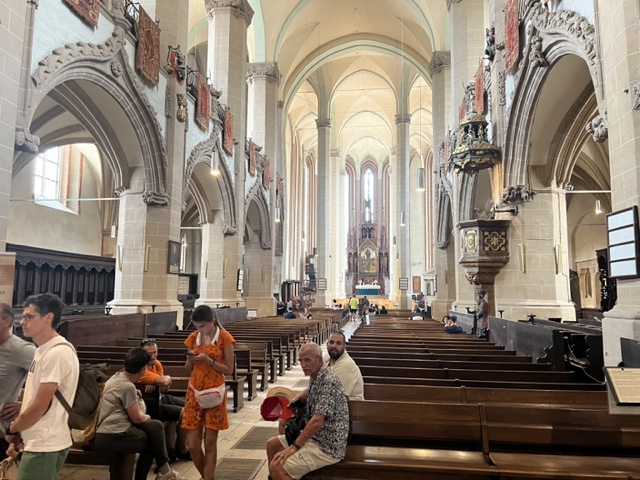
As much as I enjoyed my time in the Black Church, I must confess to some mixed feelings. Though not as impressive as some of the cathedrals I have visited, (which isn’t a fair comparison as this is really just a large, ornate parish church) there is much here that is of interest. Because it was so pivotal in the Reformation movement in the region, there are many reminders of the church’s illustrious past. In particular, there are two impressive paintings on display, one of Martin Luther, the great reformer, and the other of Johannes Honterus reading his “Booklet of the Reform” to the local authorities.


There are also a large and important collection of beautiful antique Anatolian (Turkish) rugs that have been donated by local merchants over the years. It is quite likely the largest such collection outside Turkey itself.
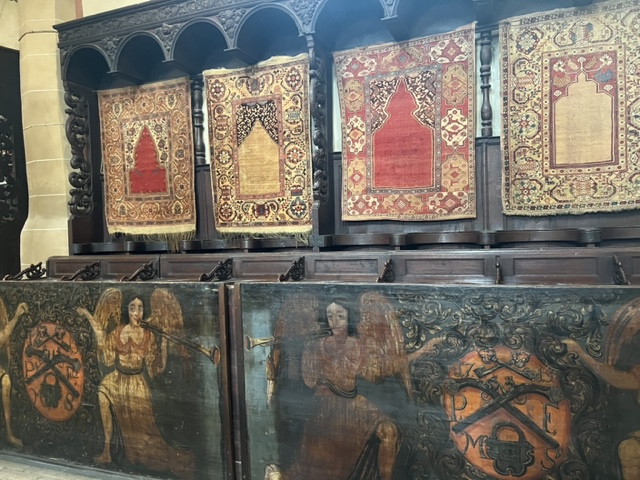
Even more prominent are the elaborate stalls set aside for city dignitaries and for members of the city’s early guilds, such as the tailors and the carpenters. They cover much of the aisles to either side of the nave. I think it was these that made me stop and think.
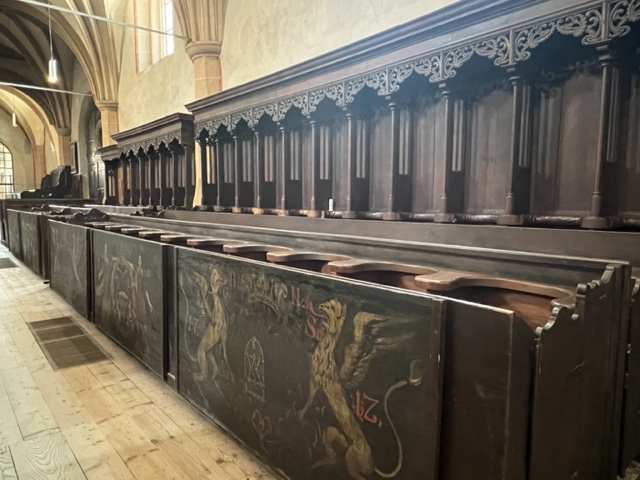
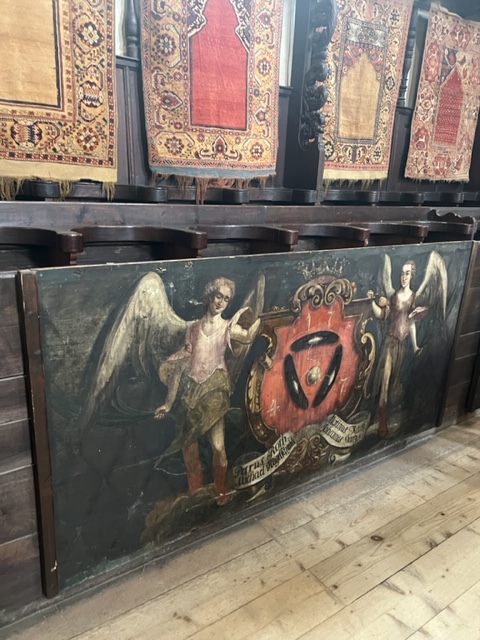
While there is undoubtedly some benefit in the participation of these important civic leaders in the life of the Church, I couldn’t help but be reminded of the passage found in James chapter 1:
James 2:1-4 “My brothers, show no partiality as you hold the faith in our Lord Jesus Christ, the Lord of glory. 2 For if a man wearing a gold ring and fine clothing comes into your assembly, and a poor man in shabby clothing also comes in, 3 and if you pay attention to the one who wears the fine clothing and say, “You sit here in a good place,” while you say to the poor man, ‘You stand over there,’ or, ‘Sit down at my feet,’ 4 have you not then made distinctions among yourselves and become judges with evil thoughts?”
ESV
It isn’t for me to judge the motives that resulted in these ostentatious displays of civic pride. In fact, we see modern vestiges of a similar impulse in stained glass windows and pews “Provided by” or “Dedicated to” individuals and organizations. But, for me, it was a timely reminder that motives matter and that the primary care of the Church should be to honor God rather than ourselves.
References
Wikipedia. (n.d.). Retrieved from https://en.wikipedia.org/wiki/Evangelical_Church_of_the_Augsburg_Confession_in_Romania
 James B. Shannon